Portfolio company of Proto Axiom
NanoSurface™ · close-up
In-cell self-assembly
Particle scale
≈ 0.5 µm
North Sydney · Sub-micron affinity nanoparticles

Bioprocessing
reimagined.

Sub-micron affinity particles, grown inside engineered bacteria. Chromatography-free antibody purification, at scale.

Scroll
Proof points
>100×smaller than resins
90%IgG bound in 30 s
30×higher shear resistance
01The market

The downstream step is the bottleneck.

Two technologies dominate antibody purification today, and both were engineered for a previous era of biomanufacturing. The economics, the footprint and the scaling profile no longer line up with where biologics demand is heading.

Chromatography columns

High-cost protein A resins. Pressure-limited packed columns with slow cycles, complex skids and heavy buffer consumption.

Membrane systems

Single-use systems constrained by pressure and surface area. Scale comes through cassette multiplication rather than true process intensification.

A new purification architecture

Biologically manufactured affinity particles designed for fast-flow processing, lower infrastructure intensity, and scalable throughput.

02Technology · NanoSurface™

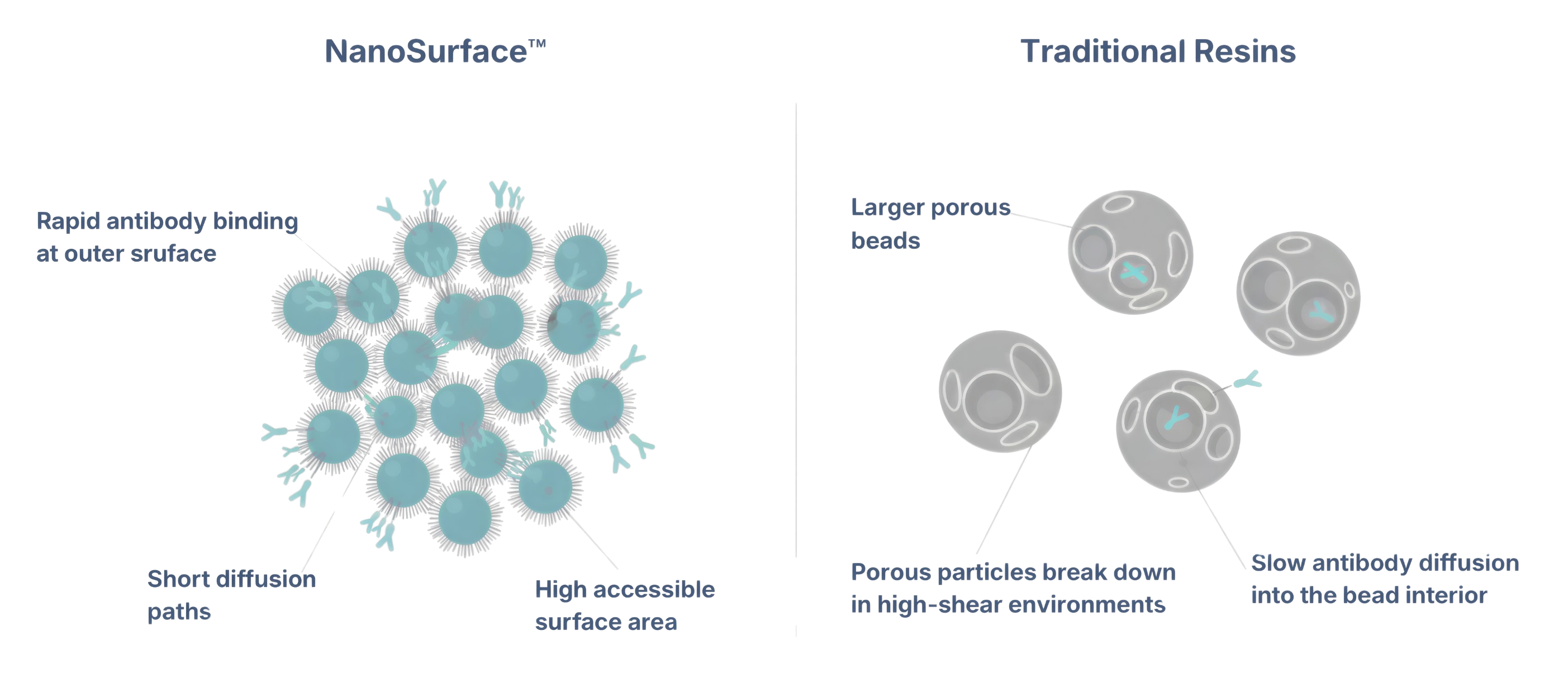
Fast surface binding without pore diffusion.

Fig. 02 · Particle architecture, to scaleNanoSurface™ 0.5–0.75 µm · Resin 50–100 µm
Side-by-side comparison: NanoSurface particle with ligands on its outer surface versus a cluster of porous traditional resin beads with internal pores.

Grown, not synthesised.

Affinity nanoparticles self-assemble inside engineered bacteria. The protein A ligand is co-expressed and arrives already conjugated to the particle surface — no chemical coupling step, and endotoxin-free.

Sub-micron by design.

At 0.5–0.75 µm the particle exposes the binding chemistry on its outer surface. Antibodies bind without diffusing into a porous interior — the kinetic bottleneck of traditional resins disappears.

Polyhydroxybutyrate matrix.

PHB is a biologically produced biopolymer formed directly inside engineered cells. The matrix is non-porous, with a carbon-neutral production pathway that avoids the multi-step synthetic manufacturing used in conventional affinity materials.

03Manufacturing

Made the way bacteria make things.

NanoSurface™ particles are produced by standard fermentation in engineered bacterial strains. The particles assemble inside the cell; harvest and lysis release them, already functionalised. No specialised manufacturing line, no synthetic resin chemistry, no chemical coupling step.

Single-stepBiological production
Coupling-freeNo chemical step
CustomisableSurface functionalisation
High-throughputSuspension capture
Fig. 03 · In-cell self-assembly
04Platform

Two formats. One particle architecture.

NanoFlo™ and NanoMag™ are the same nanoparticle deployed in two downstream workflows — continuous TFF capture and R&D workflows. Customisation extends the platform to bespoke ligand chemistries, customised for your process.

NanoFlo™ · Suspension

Continuous capture
over TFF.

A suspension-format particle that pairs with standard tangential flow filtration to deliver chromatography-free capture. Direct integration with perfusion bioreactors; supports both batch and continuous mAb processing.

Particle size0.5 µm ± 20%
Binding capacity70 mg IgG / g
Concentration200 mg / mL
Stability12 months
LigandRecombinant protein A
MatrixNon-porous PHB
Fig. 04 · TFF workflow
NanoMag™ · Magnetic

Bind. Separate.
Wash. Elute.

Superparamagnetic affinity beads with mechanical robustness for industrial use. A four-step protocol with magnetic clearance in three seconds — suitable for benchtop development through to high-throughput GMP.

Particle size0.75 µm
Binding capacity50 mg IgG / g
Clearance time~3 seconds
Concentration50 mg / mL
LigandProtein A derivative
MatrixSuperparamagnetic
Fig. 05 · 3 s magnetic clearance

Cost-efficient. Greener. Scaleable. Simpler.

Where NanoFlo™ sits against the two incumbent approaches to mAb capture, on the four metrics investors and process engineers actually weigh.

ColumnsProtein A resin + skidMembranesSingle-use cassettesNanoFlo™Suspension over TFF
CostHigh. Protein A resins + complex skids.High. Single-use system economics.50%+ lower. Natural material, no coupling step.
SustainabilityHeavy water and buffer use.Significant plastic waste.Carbon-neutral PHB biopolymer.
ScalabilityHard to scale — pressure and compression limits.Linear via added cassettes; constrained by pressure.Input-based — adjust particle dose, not hardware.
SimplicityComplex setup. Slow cycles. Column repacking.Hardware + modules; easier than columns.Drops into existing TFF. No specialised skids.
05Sustainability

A commercial advantage that happens to be cleaner.

NanoSurface™ removes synthetic resin manufacturing and chemical coupling, and lowers water and buffer load from the downstream process.

01

Carbon-neutral biopolymer

Fully organic PHB matrix produced through a carbon-neutral biological pathway rather than petroleum-derived synthesis.

02

No synthetic resin chemistry

Eliminates complex multi-step chemical synthesis in resin manufacturing.

03

Lower water & buffer load

Continuous capture over TFF reduces buffer consumption per gram of product captured.

04

Regulatory tailwind

Aligned with ESG-linked capital and the next decade of pharma sustainability reporting.

06Alpha programme

Run NanoFlo™ & NanoMag™ in your workflow today.

We are accepting a small number of process development teams into the NanoFlo™ alpha programme. The goal is concrete: validate the particle inside your own mAb capture workflow against your existing unit operations.

Apply for alpha accesstony@protoaxiom.com
01
Suspension particle and continuous TFF protocol, shipped under MTA.
02
Joint protocol design with our process science team.
03
Confidential, head-to-head benchmarking against your incumbent capture step.
07Team

Built by the people who built the science.

08Twenty years of work

The science isn't new. The moment is.

From benchtop biology
to a 400 L fermenter.

NanoSurface™ has been de-risked over two decades of academic and translational work. The 2026 Proto Axiom partnership puts the platform into a commercial vehicle for the first time.

  1. 2006First proof of concept — biologically assembled affinity particles.
  2. 2019Technology feasibility established. Key risks retired.
  3. 2020Australian Research Council grant.
  4. 2021CSL Global Innovation Award.
  5. 2024Australian Economic Accelerator (AEA) grant.
  6. 2024400 L fermenter scale achieved. Tech transfer complete.
  7. 2024Luminex Health Tech Accelerator.
  8. 2026Proto Axiom partnership.
09Contact

For investors, partners, and process teams.

Write to us at
tony@protoaxiom.com.

Office80 Mount Street, North Sydney, NSW 2060, Australia
ProgrammeNanoFlo™ alpha · accepting partners
PortfolioA Proto Axiom platform company